



.avif)
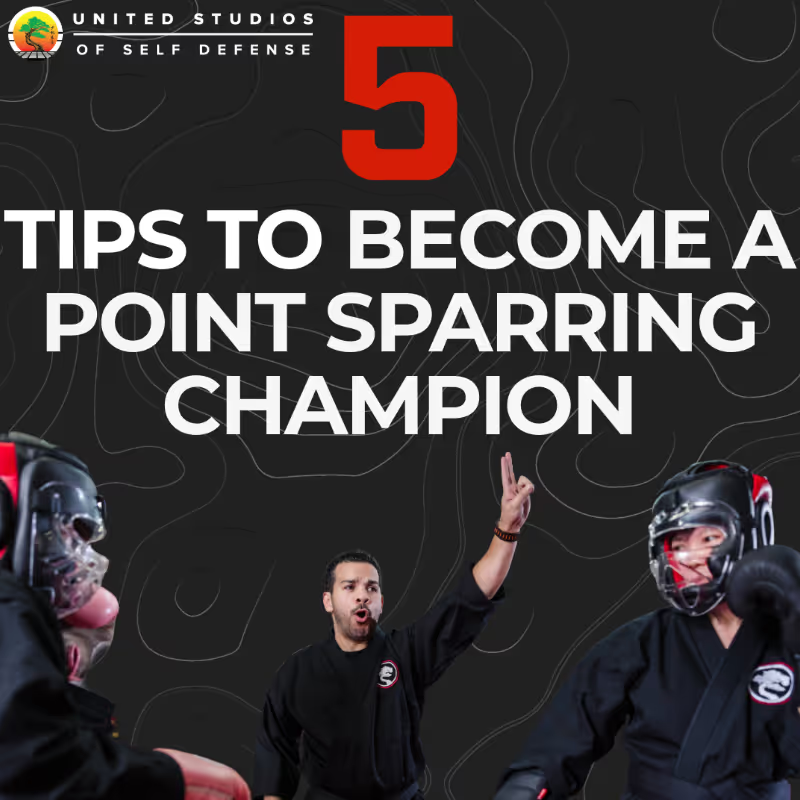
Top 5 Tips to Become a Point Sparring Champion
Point sparring is a game of timing and precision. Follow up, score decisively, stay composed, and win exchanges. Tournament champions aren’t trying to “hit harder” — they’re trying to control timing, distance, and decisions so they can score first and protect the lead.
Here are five fundamentals that separate good competitors from consistent winners.
1) Timing: Finding Rhythm (and breaking it)
Every match has a rhythm, and as your match goes on patterns begin to emerge. The moment you can feel that rhythm, you can start winning exchanges by choosing exactly when to attack.
A powerful timing concept here is syncopation. In music, syncopation is the disruption of expected beats — emphasizing the “off-beat” so it surprises the listener. In sparring, it’s the same idea: you change the expected rhythm to throw off your opponent’s response.
What syncopation looks like in point sparring
- You go between their bounce instead of matching it
- You attack right as they reset (Great for people that have a habit of dropping their hands after an exchange)
Learn more about breaking rhythm with this quick clip from Master Rodriguez.
2) Gauging: Understanding Space
Gauging is your ability to manage distance — knowing how far you are, what can score from there, and how to adjust.
Let’s break it up into using your lead leg or your rear leg. Your lead leg is the leg that’s closest to your opponent in a fighting stance— your rear leg is the leg that’s furthest.
Use lead leg work when:
- You want to keep distance with your opponent.
- You want to emphasize speed when striking.
Rear leg attacks shine when:
- You need to close the gap decisively.
- Your opponent is backing up or drifting out of range.
- You're looking to land a spinning kick.
Important point sparring note: Control matters, especially when kicking to the head. USSD emphasizes having clean technique and contact levels that keep competitors safe and prevent penalties or disqualification.
3) Footwork: Law of the Circle and the Line
Footwork is how you win position without forcing it. Instead of moving straight back, champions learn to circle and take angles so they can limit what their opponent can throw.
“Just as the circle can overcome the line, the line can overcome the circle.”
This connects directly to a classic Shaolin Kempo principle: “The Law of the Circle and the Line” — using circular movement to beat straight-line pressure, and using linear movement when an opponent’s attack is circular.
How to apply Circle vs. Line in point sparring
- When an opponent drives straight in: circle to reduce their clean line of attack
- When their attack gets wide and circular: use a clean, direct line to score first.
A practical cue for competitors
Pick a side to circle to to limit your opponent’s attacks.
By consistently circling one direction (based on stance matchups and what you see), you can reduce the number of weapons they can comfortably line up.
4) Feints: Create Openings, Spar with Strategy
A good feint isn’t just a fake — it’s a way to get information.
You show your opponent something just enough to make them react, and then you pay attention. Do they drop their hands when they think a kick is coming? Do they lean back? Do they reach to block? Do they step to the same side every time?
Those little habits are gold(medals) in point sparring, because once you understand someone’s reactions, you can stop guessing and start planning. That’s where strategy comes from: you feint to make them commit, and then you score on the opening their reaction creates.
Feint tips you can use right away
- Shoulder Feint: give a quick shoulder twitch as though you’re committing with a punch.
- Kick Feint: lift the knee or turn the hip like a kick is coming.
- Feint with Your Eyes: Rather than paying attention to pivot points, you may find your opponent looking right into your eyes. Take advantage of their habit by looking low and striking high.
5) The Blitz
In point sparring, great follow-up doesn’t mean “wild pressure.” It means controlled striking and footwork that create openings and overwhelms your opponents defense.
The essence of a strong blitz is commitment and explosivity: your sudden attack will confuse an opponent’s decision-making and overwhelm their ability to defend.
How to blitz
- You have to commit! Close the distance— there's no such thing as a half-way blitz.
- Follow up with a series of strikes to different targets.
- You can’t worry about “not getting scored on”, take your point
To learn more, check out this clip from Master Rodriguez.
Finally: Tie It Together
The real fun begins when you start linking these skills together. Try feinting to draw a reaction, then blitzing into the opening. Or use footwork to set up your kick. Break rhythm, then follow up. When you start chaining timing, distance, movement, and follow-ups, point sparring becomes less about hoping something lands—and more about creating the moment you want.
Now, take your knowledge, bring it into your dojo and train with your fellow student. Iron sharpens iron— when we compete together, we grow together. When the next tournament comes around, you'll all be ready to compete.


.avif)
